
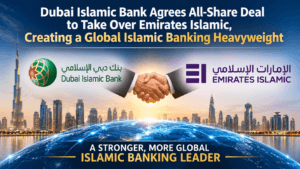
UAE – Dubai Islamic Bank (DIB) has agreed to acquire Emirates Islamic Bank from Emirates NBD. The deal would make DIB the largest Islamic banking group in the UAE and the second-largest listed Islamic banking group in the world by total assets.
Both boards have approved the transaction, and the two banks have signed a share purchase agreement. Under it, DIB will buy 100% of Emirates Islamic, which is currently wholly owned by Emirates NBD. DIB will pay entirely in newly issued DIB shares, with no cash changing hands. Emirates NBD, Dubai’s largest financial institution, will therefore become a significant strategic shareholder in the enlarged DIB.
The deal still needs regulatory and shareholder approval.
A combined balance sheet of AED 585 billion
Using figures as at 30 September 2026, the combined group would hold about AED 585 billion (around US$159.3 billion) in total assets.
The two businesses fit together well. DIB is strong in corporate banking, and Emirates Islamic has a well-established retail and deposit franchise. The merged group should be able to offer financing, savings, payments and investment services to individuals, businesses and institutions across the UAE.
Both banks expect the extra scale to fund more investment in digital capabilities, new products and service delivery. They also say it will increase the group’s capacity to finance projects that support Dubai’s and the UAE’s economic development.
The strategic rationale
For DIB, the main attractions are faster growth, a larger customer base and a stronger funding position. Emirates Islamic’s deposit base is expected to improve the combined group’s funding mix, and lower funding costs could help net financing margins.
For Emirates NBD, taking payment in shares means it and its shareholders keep a stake in the combined bank’s future growth and dividends.
Both sides see room to cut costs by sharing infrastructure, rationalising the branch network and simplifying operations. Selling more products to each other’s customers should bring in extra revenue. Over time, these gains are expected to support profitability, build capital and lift shareholder returns. The banks are clear that this depends on completing the deal and integrating the two businesses successfully.
What the chairmen said
H.H. Sheikh Ahmed bin Saeed Al Maktoum, Chairman of Emirates NBD, called the deal a chance for Dubai to create a leading Islamic banking champion. He said Emirates NBD’s stake in the enlarged DIB shows its long-term commitment to the institution.
Fadhel Abdulbaqi Al Ali, Chairman of DIB, called the announcement “a defining moment for DIB and for Islamic finance.” He pointed out that DIB opened 50 years ago as the world’s first Islamic bank. In his view, the acquisition gives it the scale to compete with the largest financial institutions globally and strengthens Dubai’s position as the global capital of Islamic finance.
Approvals and advisers
The deal still needs final approval from the Central Bank of the UAE, the Capital Markets Authority and other relevant authorities, as well as from shareholders.
DIB’s advisers:
Emirates NBD’s advisers:
Why it matters
The deal reflects a wider trend of consolidation in Gulf banking, as institutions look for scale so they can invest in technology and compete regionally and globally. For banking leaders in the Middle East and beyond, it shows how Islamic finance is moving from niche to mainstream, and how digital investment and efficiency are now central to strategy.
Re-disseminated by SINGFIN

