
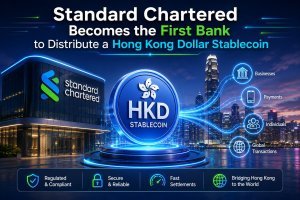
Hong Kong – Standard Chartered has become the first bank to act as a distributor for one of Hong Kong’s two regulated stablecoins. The bank confirmed on Monday that it will help eligible institutional clients and partners integrate HKDAP, the Hong Kong dollar token issued by Anchorpoint Financial, in which Standard Chartered holds a majority stake.
The initial focus is institutional rather than retail. Standard Chartered has flagged a set of commercial applications due over the coming month, covering fund subscriptions, settlement with asset managers, intragroup settlement across its own global network and cross-border payments.
Anchorpoint started a limited rollout of HKDAP on 12 August, roughly four months after securing one of the first two issuer licences granted in the city. Access channels and cross-border use cases are due to widen from there.
HSBC holds the other founding licence and is preparing its own stablecoin for the second half of 2026, with PayMe and its 3.3 million users reported as a likely distribution channel. That would take the Hong Kong market straight from institutional settlement into consumer-scale payments.
Elsewhere in the same market, Kraken parent Payward has been building out its Hong Kong stablecoin capability, including a 600 million dollar agreement to acquire Reap Technologies.
Two details in this announcement deserve more attention than the headline.
The first is the ownership structure. Standard Chartered is not distributing a third party’s token. It is the majority shareholder of the issuer, which puts issuance and distribution inside the same group. That is a very different proposition from a bank simply providing access to someone else’s stablecoin, and it raises questions that regulators, competitors and treasurers will all want answered about reserve management, conflicts and client choice.
The second is intragroup settlement. Buried in the list of use cases is a bank planning to move its own money around its own network using a stablecoin. That is not a customer product. It is a balance sheet and liquidity decision, and it suggests the internal economics already work.
For banks in markets watching Hong Kong closely, and there are many across the Gulf, Africa and Southeast Asia, the sequence is instructive. Regulation first, institutional settlement second, consumer distribution third. The competitive question is no longer whether a bank should engage with stablecoins. It is whether it wants to issue, distribute, or simply hold the relationship with the client who does both.
Re-disseminated by SINGFIN

